Some things never change. Even in the age of Twitterati and social media, female friendship can remain as deceptive and fraught as ever, or so Yellowface shows us, foundering on the rocks of personal ambition and betrayal.
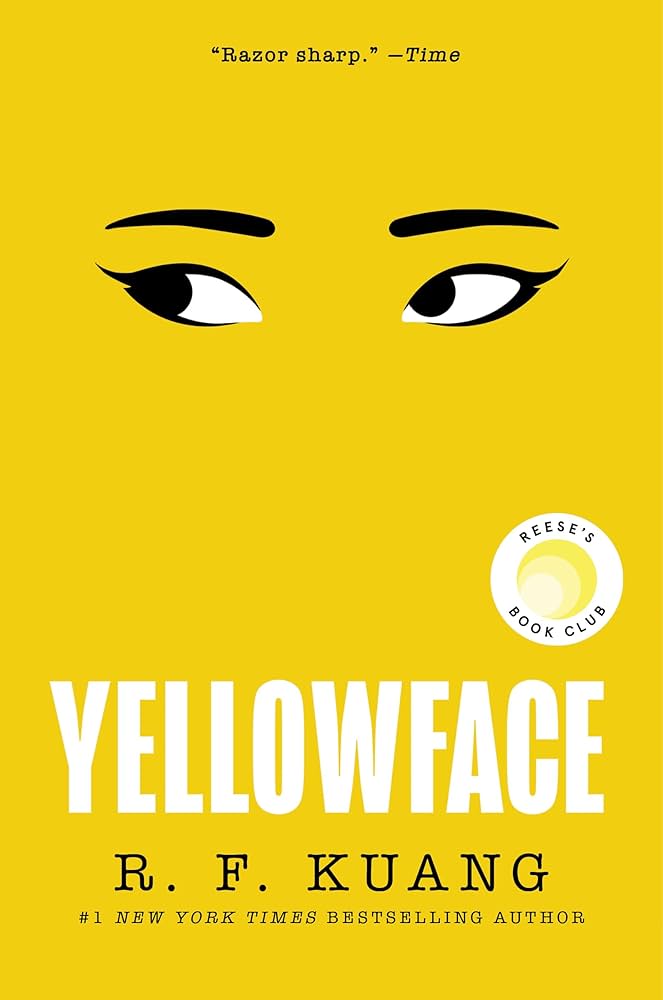
June, the narrator of Kuang’s Yellowface, and her ‘friend’ Athena are both highly educated writers, recent Yale graduates aiming for the very top in their writing careers. The important difference is that where Athena appears effortlessly successful, with endless book deals, bestsellers and film contracts coming her way, June is having a tougher time. That’s where the trouble begins . . .
June has disappointing sales on her first book, which doesn’t even make it into paperback, and is miserably jealousy of her former classmate, whose success rankles with her. In contrast, Athena is operating in a grander, more elevated sphere. It’s one from which she makes the only the odd patronising phone call to her old mucker.
Things take a darker (and slightly unbelievable) turn when Athena chokes to death during a late-night pancake-eating competition the two stage after an evening drinking together. Although June initially claims to have helped Athena in her hour of need, we later see a different, darker (and, sadly, more believable) version of events.
Despite the melodrama of poor Athena’s death, much the book’s power comes from its prosaic believability, its accurate depiction of the echo chamber forming social media that surrounds 21st century friendship. Yes, while the message of jealousy, rivalry and betrayal may remain the same, the medium for these battles has transferred on-line.
The novel also captures student life in all its horrors, from the picture of groups of nervous freshers awkwardly socialising with each other in their first term to June’s drink-sozzled and traumatic ‘encounter’ with a male student who might (or might not) have raped her.

We’re never made entirely sure what happens to June but we are sure, however, that the night has left her badly traumatised, so much so she’s revolted at herself as well as the situation. And we really feel for her, crucially, which is clever, given that June goes on to commit some highly morally dubious acts.
The account of drunken fumbling – or worse – following a student party is measured and accurate. It’s a relief to see the code of shameful secrecy about these gruesome encounters being lifted. “Not every girl has a rape story,” thinks June. “But almost every girl has an “I’m not sure, I didn’t like it, but I can’t quite call it rape” story.” Horribly true, at least in my experience.
June’s backstory not only taps into the #MeToo movement, it also makes us sympathise with her. Even as we see her steal her dead rival’s manuscript and attempt to pass it off as her own, we remember what she’s been through, which allows us to retain some limited sympathy for her, although we remain conflicted and horrified by her actions.
Kuang is great on plotting and dramatic irony, piling it on when she shows Athena as the one comforting June after the possible rape. We’re later upset when we discover Athena using June’s distress almost word for word as material for her new book. “I couldn’t […] overlook the similarity between the phrases I’d used when describing my pain and the phrases Athena used in her story. I couldn’t unlink Athena’s prose from the memory of her doe-like brown eyes, blinking in sympathy as I told her every black, ugly thing in my heart between choked sobs,” thinks June. Again, we begin to think that maybe it isn’t so bad that June steals Athena’s material. Still wrong, yes, but perhaps at least more understandable?
Across the novel the plotting is equally meticulous, meaning that when we get to the dénouement it has the visceral impact of a blow to the stomach. It’s only in retrospect you notice how skilfully Kuang has hidden the clues to what is really happening.
Kuang isn’t just brilliant on plotting and the jealousy underpinning so much female ‘friendship’. She’s uncannily accurate on first jobbing in publishing. After one woman in Yellowface gets fired she’s so broke she’s forced to sleep in a friend’s bathtub for weeks on end, determined to land a new job even after mountains of rejections. Others are overworked to the point of nervous collapse and the pay is barely enough for them to cover food and lodging.
I often used to wish I was young and healthy again, full of that old zest for life as I tried to make my way in my chosen branch of the media – newspapers and magazines. No longer. After reading Yellowface I now just feel thankful to have escaped a world where we can even imagine people’s dreams potentially pushing them into such extreme behaviour.
The book ends with June plotting a self-referential book about her experiences with Athena and the tangled web linking the two of them. Naturally, news of the book will be leaked on social media, the chosen forum and engine for much of the story. Is anything properly ‘original’ anymore, asks Yellowface? Or do we live in such a narrowly self-referential world that all writers can do is echo each other in varying degrees of intensity? Kuang’s answers to these questions do not make for comfortable reading.
Yellowface
Rebecca F. Kuang
The Borough Press
£16.99 published May 2023
 Helen Fowler Writer