
Pileated woodpeckers – meaning they have fancy crests
Cuckoos enchant us
There were times I was uncomfortably aware of the deeper meaning of Cloud Cuckoo Land eluding me as I read, but I eventually managed to work out what was happening. Roughly. And ironically, last week we ended up having one of our most successful book club discussions in many months about the title, a story that circles around different stories, all of them in their different ways eulogies to the book.
Helpfully, author Anthony Doerr writes about the book on his blog, explaining those parts I hadn’t understood. “Cloud Cuckoo Land was a phrase invented by the comic playwright Aristophanes 2,400 years ago in The Birds,” he notes.
Inside the single book, continues Doerr, “are five-novels-in-one, each braided around the others.” All of Cloud Cuckoo Land’s five strands follows different protagonists, who connect with each other through a sixth novel, an imaginary ancient text about a shepherd’s journey to a Utopian city in the sky.
Faithful oxen follow too
There’s Anna, who lives and works in an embroidery house in 15th century Constantinople, desperate to learn to read and explore the wider world. Early in the novel, Anna marvels at the sight of an ancient fresco in an archer’s turret. Each time she looks at it, “something stirs inside her, some inarticulable sense of the pull of distant places, of the immensity of the world and her own smallness inside it.” Omeir (one of my personal favourites) is a kind boy who lives with a cleft lip in what is now Bulgaria. Only after he is conscripted into the Ottoman army to attack Constantinople do he and the restless Anna eventually meet. With him go his faithful oxen, Moonlight and Tree, whom Omeir loves faithfully, (and whom we readers cannot help but love too).

As for the other characters, Konstance appears to be living in outer space, where she’s being bullied by a bossy AI system named Sybil. Poor, tortured Seymour is working to survive life in present-day Idaho despite the many obstacles facing him. As readers, we can hardly help but warm to Seymour and his mother; they’re such humble, decent people, who’ve been pushed to the margins of life, with the odds stacked against them. Poor Zeno is the fifth of these characters, a translator and covert homosexual who’s forced to miss out on any meaningful sexual or romantic connections because of his controlling family.
Mutton-headed?
Appearing intermittently between the five of them is an entertaining character named Aethon. “A dull-witted, mutton-headed lamebrain,” writes Doerr, in typically pithy description. Greek mythology suggested Aethon was one of four immortal horses pulling sun god Helios’ chariot across the sky, but in Cloud Cuckoo Land Aethon is a shepherd who dreams of becoming a bird and flying to a magical land.
Slowly, parallels and connections between stories and people, baffling and yet powerful, begin to emerge. Omeir’s cleft lip has forced his parents to flee their village, locals insisting he’s touched by the devil, in much the same way that Seymour and Zeno have had to leave their homes too. All retain a quiet decency, despite their traumas and troubles.
Omeir’s journey eventually intertwines with that of Anna after he joins the enemy troops invading Constantinople. It’s a relief and a delight that Omeir treats Anna with respect and kindness, making us warm further to him. But the most poignant of them all (for me, at least) is poor Seymour, trapped in poverty in Lakeport, Idaho with single mum Bonnie. Neurally diverse, Seymour is a sensitive boy, thoughtful and nature-loving, vulnerable to predators.
Every day that summer, as soon as Bunny [his mother] leaves for the Aspen Leaf [where she works], Seymour pours Cheerios into a baggie, heads out the sliding door, passes the egg-shaped boulder, and slips under the wire.
He makes Frisbees from plates of bark, pole-vaults over puddles, rolls rocks down slopes, befriends a pileated woodpecker.
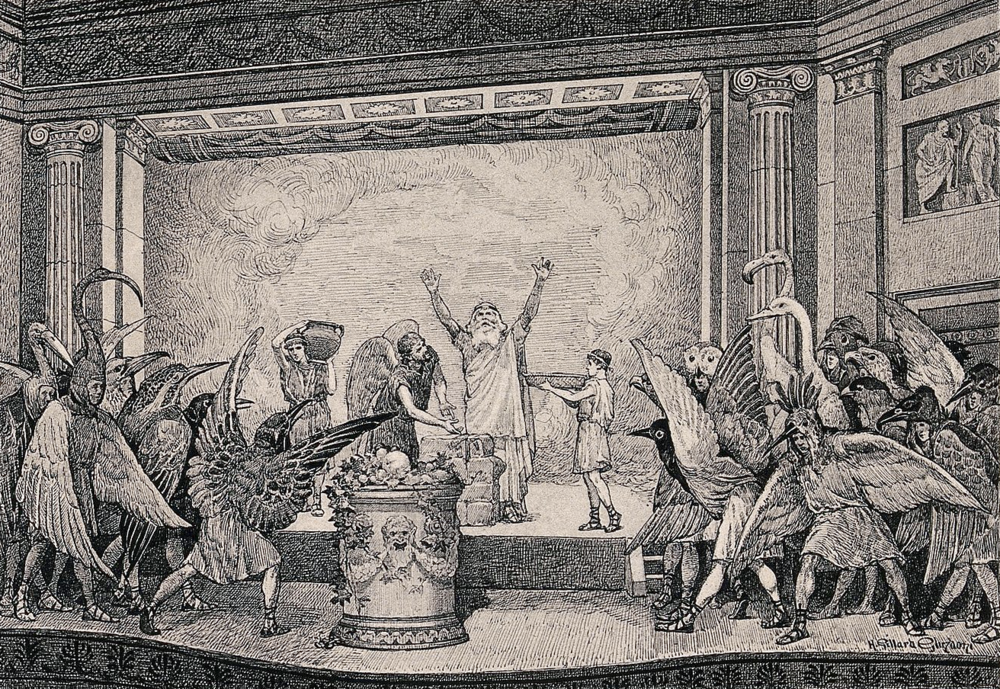
A performance of ‘The Birds’ by Aristophanes
Only connect
Poor Seymour becomes the target of internet predators, and we’re forced to watch in dismay as he’s lured into terrorism. His anguish (and ours, too) worsens when he sees the open space around his home that he loved so much being targeted by property developers.
Pieces of ancient text connect these five characters, all of them wounded outsiders and all, at separate times, serving in different ways as guardians of the material.
“I wanted to continually rotate the story around the running theme of sieges-inside-sieges, libraries-inside-libraries, worlds-inside-worlds,” writes Doerr. I’d argue that Doerr succeeds in this, creating a novel that feels like the literary equivalent of a Rubik’s cube. Tricky to fathom out, impossible to abandon or forget. Perhaps one of Doerr’s greatest triumphs is his ability to write this book-about-books without ever once even coming close to pretentious, instead drawing us further and further into this special magic written in praise of the written word.
 Helen Fowler Writer