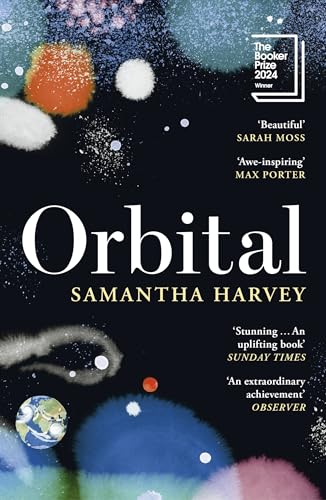
Half a dozen astronauts circle the planet earth from outer space in this odd, rhapsodic novel about a gravity-free voyage in which the travellers see everything – food, water, cutlery, sleep, sex, toilet arrangements, themselves – from a different angle. In many ways, it’s a story about our planet as seen by outsiders. And, also, the fresh perspectives that can result from belonging nowhere.
A parody?
For a while I thought there must be something wrong with me for not enjoying this slim volume more. After all, it won the 2024 Booker prize, when critics raved about it as ‘beautiful’, ‘exquisite’, ‘gorgeous’ and ‘luminous’. Yet in places it reads as a parody of itself; some of the lusher descriptions could even feature in Pseuds Corner.
Here’s Harvey on seeing our planet from space: ‘There’s the first dumbfounding view of earth, a hunk of tourmaline, no a cantaloupe, an eye, lilac orange almond mauve white magenta bruised textured shellac-ed splendour’. Personally, I kept having to break off from reading to get my bearings again amid this dense text, to breathe, although that might just be my fault.
Salt cubes
Where Harvey is at her best, I’d argue, is in the telling small details of life aboard the space station. For example, at one point the astronauts turn to each in a jubilant moment but find the absence of gravity prevents them high-fiving each other ‘with sailing hands that hadn’t figured out what it meant to be weightless’. When the two Russian astronauts produce a gift for the crew in line with how things were done back home, they don’t offer the traditional bread and salt for which Russia is famous, instead producing crackers and salt cubes. ‘They all partook’, notes Harvey dryly. Some of this is funny, but I’m not sure that’s the intended effect.
Cold comfort
The descriptive text is indeed beautiful. And the research that must have gone into Orbital phenomenal. When one of the astronauts cries, for example, someone hastens to gather up their tears in a plastic pouch in case the floating drops of liquid damage the engineering. We don’t find out if anyone comforts the weeping astronaut.
The problem, at least for me, is the absence of narrative drive and characterisation. It’s hard to avoid thinking this novella might have worked better as a poem, or even an essay, given the floating point of view; eery, ethereal ambience and detached perspective.
Not encouraged: fancying crew mates
There are touches of humanity here and there: one of the astronauts is horrified when he finds himself fancying a female crew mate, which is presumably against the rules. The poor man is so embarrassed after some erotic dreams about her he can’t bring himself to look her in the eye; we feel for him.
And, in fairness, the book does use defamiliarisation adroitly, taking the outsider perspective to a logical extreme. We see good old terra firma all right, but not like we’ve ever seen her before. Viewed by six astronauts circling the earth from two hundred and fifty miles above, things look different.
Land and sea
No national borders are visible from space, Harvey stresses. ‘You will see, they were told, [the earth’s] fullness, its absence of borders except those between land and sea. You’ll see no countries, just a rolling indivisible globe which knows no possibility of separation, let alone war.’ I couldn’t stop thinking of 1970s pop group The Brotherhood of Man on reading some of this stuff and silently giggling.
Papua New Guinea cut asunder
National borders may indeed become invisible seen from outer space, but the astronauts do get to see what Harvey describes as ‘that sharp boundary line between day and night that falls across the full girth of the planet. It slices Papua New Guinea in two. This half is daylight, that half dark’.
Not as we know it, Jim
Time, at least as we know it, doesn’t exist in space, we learn, or not in the same way. The book opens with the mention of a birthday banner, noting that it wasn’t anyone’s special day, but that was all they had to celebrate festivities. The banner leads us to start thinking about how traditional birthdays can’t really exist on a spaceship; we’re told that in twenty-four hours the ship has orbited the earth sixteen times, a period that would have lasted more than a fortnight on earth itself. Here on the ship, however, no more than a ‘day’ passes. Birthdays cannot exist in space for any longer than the earth equivalent of one and a half hours, by my reckoning.
Where’s the narrative?
I confess I had to force myself to read onto the end of Orbital, which I managed to do, but the absence of narrative made it difficult to engage. That said, every time I go back to the novel I see new meaning in it and remember how the descriptions are so breathtaking. Not a book for anyone who loves conflict, intrigue and personality, though, I’d say.
 Helen Fowler Writer