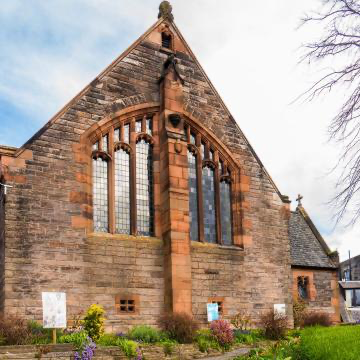
A church called The Good Shepherd has found harbour on top of a small hill on the edges of the city of Edinburgh, and from here it offers refuge to others in its turn, supporting all who are lost, despairing or lonely. It helps that the church projects more than a hint of upturned ark, its shape mirroring that of Noah’s famous vessel that kept so many afloat in times of peril, of hardship.
The church’s arched silhouette greets you as you approach the grounds, its stonework punctuated with a panel of windows that makes up much of the wall, the small pieces of glass held together by strips of metal in a technique that goes back to the middle ages, when craftsmen in Gothic cathedrals would have routinely used the same skills.
Pushing open the freshly-painted gate leading up into the churchyard takes effort and the metal makes a squeaking sound when I open them. As I walk up the curving path leading into the church gardens, I get a better view of the two mature lime trees and hardy sycamore that reign there. Often, you hear children’s laughter from a nursery that takes place in a church outbuilding. As you turn the corner, the garden’s south-facing side comes into view, and you can see its aged stone wall studded with messages on placques from grateful parishioners and their families.
Walking into the grounds somehow promises a kind of refuge to the lost, the hurt, the disillusioned, the bereaved and the damaged, to all who have ever struggled or lost their bearings in their own private versions of the flood. Here, I forget all about having Multiple Sclerosis and my hated walking frame.
Here, at last, I feel . . . what’s that feeling again? It comes back to me. Safe. Yes, that’s it. I feel . . . safe. That prickle down my back disappears whenever I come here for my weekly meditation. Sanctuary means a place of safety, of refuge or holiness. And The Good Shepherd lives up to that, offering asylum for those in need, those with nowhere else to turn, those close to the end.
As soon as I turn into the church’s grounds, I leave behind the residential Edinburgh street of beautiful and correspondingly expensive terraced houses and the busy main road a few hundred yards away. The church isn’t just a physical place, you see, it’s offers different versions of time and space to an ordinary terrestrial sphere.
While the church could be an upturned ark or a village church, transplanted to the city, it’s neither; instead it forms a throwback to a kinder, more trusting time. The porch is often left open, available to anyone who cares to come and pray, to find sanctuary from whatever troubles and hurts them. So far, nobody has abused that trust.
This is shelter. A refuge from the harsher winds blowing outside, buffeting and threatening to destroy. There’s a connection between the words ‘heaven’ and ‘haven’ and it’s here, in this church that looks and feels like an ark sailing over the flood waters, that I feel that sense of shelter most acutely.
In springtime yellow daffodils line the winding path up to the church, dancing in the chill Edinburgh breeze, joyful at the year’s turning, their floral beauty welcoming all who come to worship. Bees will arrive shortly, studious in their attention to harvesting pollen. In summer the roses blossom, keen to attract pollinators. A couple of months later and the rose branches droop with glossy hips ready for turning into syrup.
It helps that I spent my happiest school days in what was once a grand old house with grounds just over the wall at the back of the church garden; I associate the place with the easier, safer parts of childhood.
Inside the church I feel a sort of love in the dusty, dry atmosphere. The central section is usually decorated with fresh flowers in each of the many windows. This must sound daft, but I treasure the old-fashioned kindness here. You can see it in the basket overflowing with hand-knitted hats made by parishioners for charity. It’s here, too, in the hand-made woollen tapestries fashioned into kneelers for people to rest tired knees on as they pray.
We don’t have to remain lost lambs forever, you see; there’s a kindly shepherd here who doesn’t turn away anyone in need.
 Helen Fowler Writer