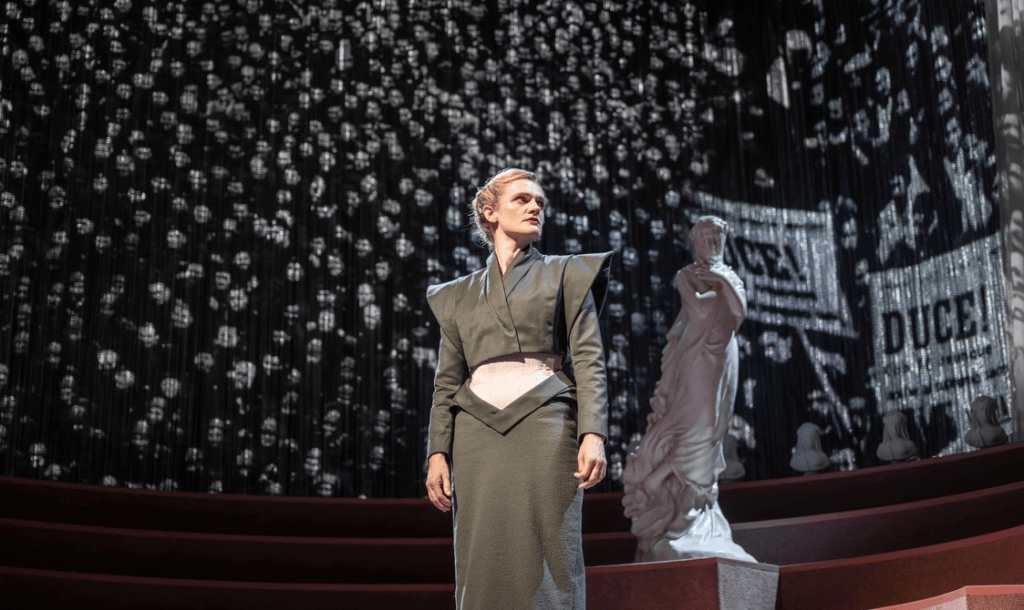
The Prime of Miss Jean Brodie, National Theatre of Scotland, touring until 7 November 2026
Wonderful and devastating, this adaptation of Muriel Spark’s novel from the talented folk at National Theatre of Scotland makes for compelling theatre directed by Vicky Featherstone.
Charisma hiding evil
The cast, led by Gayle Rankin, draws out Miss Jean Brodie’s slippery charisma and wit, showing how she uses them to attract innocent young followers to join something approaching a personality cult. We see how egoism, personal frustrations and lack of opportunities push her into supporting the fascism then threatening much of Europe.
Few could miss the parallels between 1930s fascism and today’s far-right, extremist thinking. Even more alarmingly, the show uses the places, people and language we see and hear every day in our ordinary, safe Edinburgh lives. Evil can happen anywhere, we remember.
As a teenager, I lived near James Gillespie’s High School, the Edinburgh institution thought to inspire the fictional Marcia Blaine School for Girls in the 1961 novel, The Prime of Miss Jean Brodie. It never occurred to me the school might be used as a symbol of far-right extremism and the need to fight its evils.
Beware people who chase power
Yet the novel’s power-hungry teacher grooms the kids in her ‘care’ in the same way Hitler and Mussolini rallied their supporters.
So, yes, it’s an understatement to say teachers don’t look too good in either the book or the wonderful, troubling new stage adaptation by playwright David Harrower.
I confess I’d never previously read the book or watched the 1969 movie adaptation starring Maggie Smith, one of my favourite actresses. Last week, however, I watched the production starring the beautiful Gayle Rankin as Edinburgh’s most famous, or rather infamous schoolteacher.
The show is mesmerising, showing how evil can gain a foothold anywhere. It becomes even harder-hitting when we initially meet Brodie and sympathise with her struggle to survive the death of her fiancé in world war one. At the same time, we become increasingly alarmed as she befriends a clique of the brightest students in her class, making this ‘élite’ into her favourites while openly despising other kids.
Darker version of Bridget Jones?
Brodie sinks lower, indirectly causing the death of student Joyce Emily when she encourages the young woman to travel to Spain during its 1936 – 1939 civil war. The youngster loses her life when a bomb hits her train.
We dislike and fear Brodie even more when we see her make fun of an unfortunate girl for confusedly thinking shorthand and Latin are one and the same. The nasty élitism Brodie pushes onto the class mirrors the fascism she likes so much.
Increasingly desperate for sexual freedom, Brodie begins an affair with the school’s art teacher. In the novel, the man is a one-armed war veteran. On stage, he appears physically unharmed but as an inveterate womaniser.
The male teacher could have been the Daniel Cleaver of his day, we feel, cheating and sleeping around, as Brodie lives out her darker, earlier version of Bridget Jones.
Not a good friend
Other things never change either, despite today’s access to contraception, financial freedom and political emancipation. Female friendship is shown in its grubby, compromised glory as women struggle for crumbs of a professional cake meant mostly for men.
Eventually Brodie is betrayed to the head mistress, who seizes the long-awaited opportunity to fire her.
It was a powerful experience watching the show here in Edinburgh, where so much of the novel and adaptation are set. Mentions of local places such as Princes Street, Cramond and Davidson’s Mains make the show uncomfortably close to home.
Evil can be banal
After getting home I sat down and read the novel too. Frightening, clever, brave, brilliant, both versions remind us how evil can grow even among the places and people we trust the most. Not an uplifting or comforting message, but one we need to be brave enough to remember.

